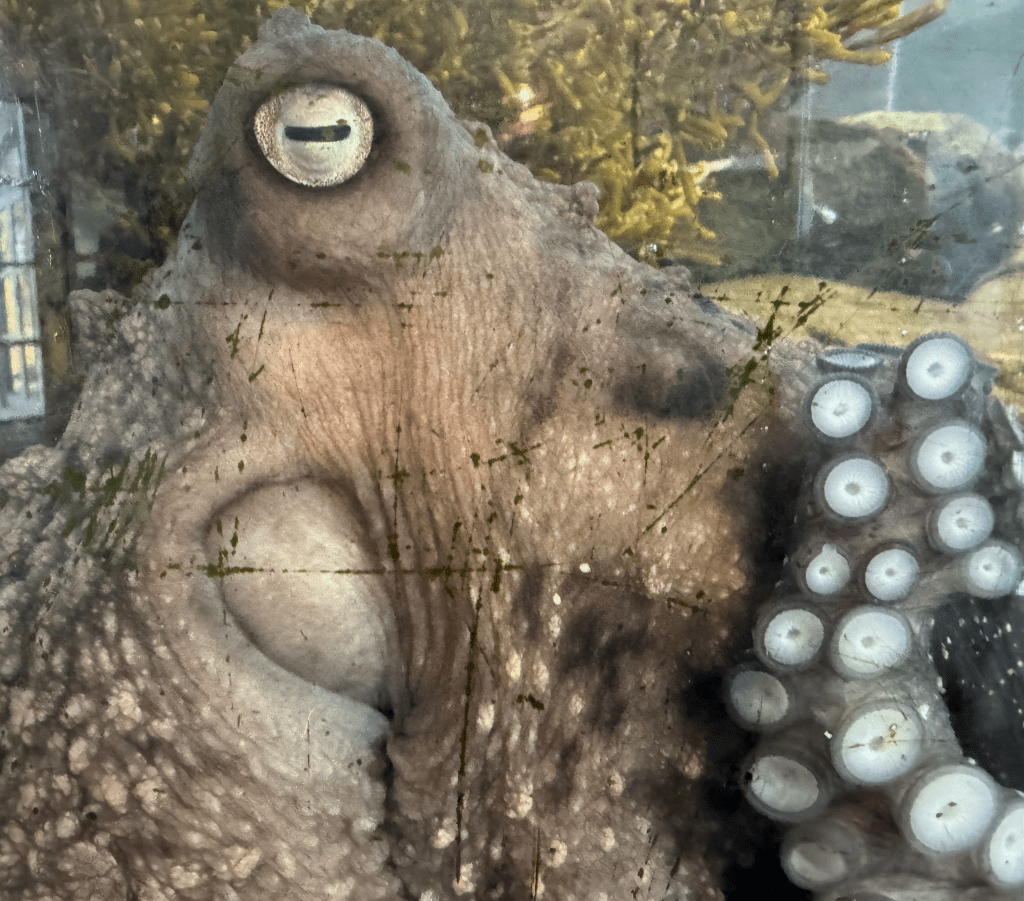
Thursday May 7th, 2024 I went to the NZ Marine-Science Center in Portobello, Dunedin to give staff and students an introductory movement workshop. One of the ideas behind this collaboration was to give participants an embodied experience of different ways of moving and decision making than they are used to. The work was designed to open their perception to experience a more decentralized embodied presence in space and time. Trying not to assume anything, we imagined possible links with how animals like octopus and other cephalopods with their special decentralized nervous systems (they have 9 brains, with one in each arm!) maneuver and interact with their environments through their multi-local pro-prioceptive intelligence.
The one hour workshop introduced fundamental movement principles in a very accessible and simple way. We playfully explored our movement possibilities using the resistance of the floor and gravity to become aware of how we use the forces of push, pull, and reach with all parts of our bodies. We began with letting our decision making, and initiation of forces into space be guided by our hands and feed and then transferred this experience to all other surfaces and parts of our bodies.
In the past the experience of this method has sometimes reminded participants of the way an octopus might simultaneously interact with multiple areas of its environment through movement. Through the physical exercises proposed, we try to decentralize the idea and sensation of where our control center is in order to enable active decision making from all parts of our body equally.
What we do felt like a ‘moving massage’ of our whole body and proposed playful and surprising ways to interact with our environment through movement – and improvisation.
We were able to watch and observe the octopus onsite for a few moments together after the workshop concluded, which as an incredible treat as he was released back into the wild on the same afternoon:
https://vimeo.com/943427100?
Octopus at the NZ Marine Science Center in Portobello, Ōtepoti – Dunedin
Some musings and reflections about octopus:
The octopus has no bones except a small tooth called its beak with which it uses to eat. It can move in any direction with any of its body parts and squeeze through a hole the size of its beak. It’s arms each have a brain and the octopus explores it’s world and environment multi-locally but can also coordinate actions through it’s central 9th brain. Through play and improvisation it quickly adapts and learns how to camouflage and find food. Some octopus can even shapeshift and mimic other octopuses. The amount of intelligence this remarkable animal displays is comparable to small invertebrates – and what is even more remarkable is that it develops these skills in just 1-2 years as most octopuses die by the age of 2.
What could we as humans learn from these incredible creatures?
What can these creatures teach us about improvisation and play?
What can they teach us about decentralized decision making?
“Perception is not something that happens to us, or in us,” writes Alva Noë. “It is something we do.”
In that sense: the way(s) that we move directly affect who and how we are – if we change the ways we move, we also will change who we are.
 all movement is dance