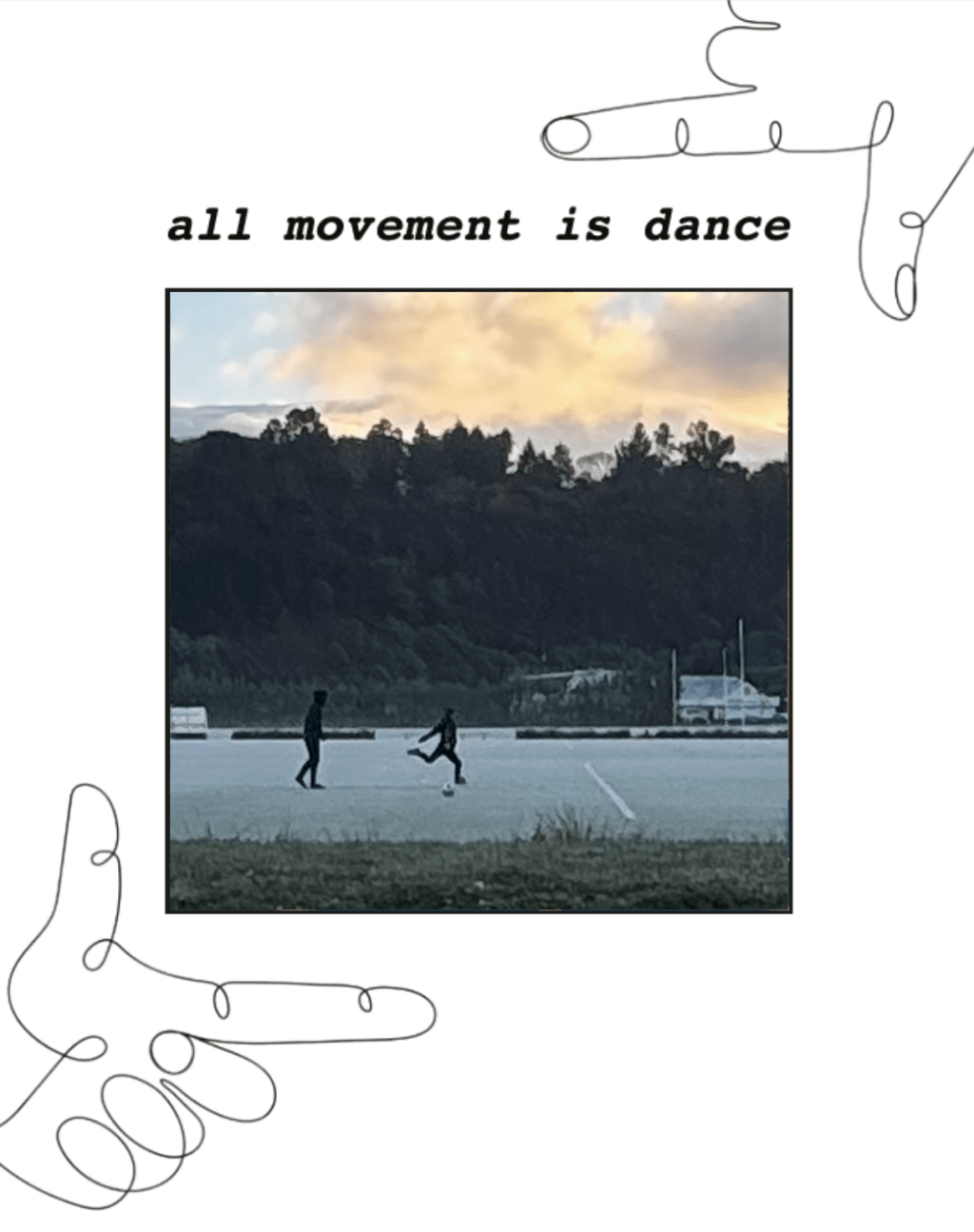
FRAMING DANCE
One of the main ideas behind the performance project selfportait24: Ōtepoti – Dunedin, as well as my work as the Caroline Plummer fellow in community dance at the University of Otago, is that “all movement is dance” if we, as artists and teachers, choose to frame it that way.
One of the most intriguing challenges for me as a teacher in connecting to members of the community through sharing my movement and dance practices is that each class is made up of participants from very diverse backgrounds and different levels of experience. This creates the unique task of finding ways to include people with diverse physical skills as well as socially and culturally diverse ideas of what movement & dance is (or isn’t).
FRAMING & UNFRAMING
With the statement “all movement is dance” I simply want to start a conversation. The statement is not meant to be dogmatic but rather by coupling “just frame it!” with “just unframe it” and “moving outside the box” I would like to encourage a playful dialogue around movement and the ways we perceive it in our day to day lives in various contexts.
Can we thing of dance as a state of being that can bring joy to our everyday lives, and also change and influence our growth, development and communications as beings on this planet? By playfully bringing dance in and out of different frames we can take back power over our own bodies and spaces – realizing that dance is a way of moving through life. It is not something you do or don’t do, can or can’t do, or something that you need a special kind of body for. It is not something to achieve but rather a way to perceive and play with the movement that is already present. This can bring little moments of joy as well as have profound effects on our decision making and ways of working and connecting with others – which in turn affects all areas of our lives.
HOW BIG CAN WE MAKE THE BUBBLE?
My larger aim is to bring contemporary dance research & performance out of the professional bubble it is often inside of, particularly in western contexts. By bubble I mean that often only professional dancers go to other professional dancers performances and often only people with extensive background in the subject seem to “get it” when they see a contemporary dance performance. Often people with no prior connection to the dance world or personal dance training feel excluded or like they are not smart enough to understand what is going. However – we all have a body, and we all move and use our bodies in different ways during every day of our lives. If we as artists frame the languages of movement in an accessible way – there is a potential to connect to everyone with movement references that are relatable.
I try to use every opportunity I get to expand the frames of what dance can be, and to make it more accessible to the general public. Because of this I value each connection to every person I meet as a chance to share the work – making each person’s perspective a welcome and integral part of the research itself. I try to use each encounter to open that particular person’s perspectives on movement & dance, while simultaneously broadening my understanding of how our common movement languages and references might connect us.
DIVERSE POINTS OF REFERENCE
When hosting a class, the range of people may vary from a trained dancer in their 30’s, a woman in her 60’s, a physical therapist, a musician, a marine scientist, a carpenter, a martial artist, a bus driver, a cricket player, to someone in administration – working behind their computer all day. The way to connect with all these different people begins with understanding what their frames for movement perception are connected to. Before beginning, I always ask each participant what their interests and experience in dance relates to, and/or what kind of movement practices they like (swimming, building, tango, surfing, martial arts, pottery, walking etc.).
What is important to consider is that people feel connected and comfortable but also challenged and inspired). For example, when there is a professional team sports player in the class it will influence me to give more attention to how we perceive and keep track of the group around us – connecting our movement to the others movements in the room (thereby creating a reference to playing in a team). I might also introduce more challenges on variations for speeds and intensity (that of course everyone is free to follow at their own pace).
I would not want someone to come out of my dance practice feeling like they are lost, “don’t get it”, or could not expand their potential. To avoid this, I try to make sure that each person present always has at least one point of reference as well as the control over their own learning speed. To include everyone in the group equally from the beginning, I will use common movement references that we all understand such as walking, or the sensations of push & pull, as I will explain in more detail below. In addition to the common references, knowing what the participants’ more specialized experiences with movement are will also help guide the class. It will spontaneously inspire me to use specific words, metaphors, or imagery (for example the action of molding a ball of clay for a sculptor/potter), that might more closely relate what they are doing in my class to their past movement experiences. This has a greater potential of making them feel as if the class is a continuation of their training, rather than putting them into a completely new or unfamiliar (and thus scary) territory.
A little anecdote: My sister Dr. Alena Giesche, a geologist, recently told me that she had participated in some emergency training: guiding participants to be able to escape out of a sinking airplane in water. One of the most important things to remember as your are going down, is to keep one hand on a physical point of reference in the plane, such as the door handle, so that you know where you are at all times. This reference point of contact will support the nervous system to avoid panic mode, because it helps you to orientate spatially and organize all your movements to escape – if, for example, murky water would enter the plane obscuring your sight.
RELATABLE SOURCES OF MOVEMENT KNOWLEDGE – Transfer of knowledge
Of course in no way I want to compare a sinking airplane to taking a dance class for the first time, but for some people it might feel just as scary – as it relates so intimately with our own bodies and our perceptions of them. I general, I try to focus participants as much as possible away from how something they are doing looks, but rather guiding them to be interested in how the movement emerges or is created by them through the tasks given. Establishing points of reference as I mentioned before, is crucial to this possibly “first time dance experience” as it helps the person focus and concentrate. For example, everybody knows what “pushing” is – so if we begin there, we can find ways to link the simple experience of pushing a hand to the floor to many more variations on pushing with all different body parts. All the time we are still working and sourcing from the original idea, but allowing it to naturally branch out, letting the body guide the learning experience and expand the physical possibilities of what the original movement (in this case pushing) could be.
To assist this process, one technique I use is the “transfer of knowledge” from one part of the body to inform another one. If we know how pushing the floor feels on our hand, we can easily transfer this to our other hand. If we know how it feels on our hands, we can easily transfer this to our feet – from there, we can transfer it to different points on the pelvis, or to any other areas or points of our body that we feel connected to the floor. All the parts of the body are connected in our awareness, meaning that the sensation or logic of how something works in one place, can be copied or transferred to another area quite easily. What is essential, is to establish one very familiar point of reference that one can always return to, in order to be able to sense and analyze the new movement situation in relationship to the original sensation. This enables the mover to stay within their realm of familiarity but at the same time allowing their bodies to surprise them – finding and exploring movement possibilities that they could never have imagined possible beforehand. Being in the state of “observation and exploration”, of noticing how movements are emerging and functioning, rather than reproducing an idea of the movements’ perceived external forms, allows each body to stay present, grounded, and connected to its senses through listening and active response – in dialogue with the body.
WALKING INTO DANCING – expanding through simple variation on a theme
Another method I often use is to begin classes with the repetitive traveling movement that almost everyone can relate to: walking. It is a wonderful point of reference because it is the movement that all of us have done the longest (even professional dancers have most likely walked more than they have danced in their lives!).
We start by walking forwards in a straight line for quite some time, in the way that we are used to walking on the street. Slowly we then begin to introduce variations on that simple movement, for example, walking backwards, turning on the axis while walking, pushing the floor to the left or right to create different pathways in space while walking, using and moving the arms while walking, speeding up or slowing down the walking, moving the spine into different orientations while walking, etc. All the time we remind ourselves and return to that original feeling of walking forwards as a physical reference, while step by step opening up more possibilities in movement direction, use of time, use of more body parts – gradually moving from the pedestrian into abstraction – and turning, almost without anyone noticing, walking into dancing 🙂
DANCING IN THE DARK
To close this post, connecting further with the theme of inclusivity, I want to cite one more thing that inspired me:
I recently got an Ōtago Bulletin Newsletter where I read about Karyn Paringatai – teacher of MAOR108 Waiata: Te Tīmatanga an introduction to various forms of waiata and haka leading towards performance – one of the largest papers (NZ term for “class”) at the University of Ōtago (LINK to article “Bright Future for teaching in the Dark”). Often in her classes, she noticed that many students felt very uncomfortable with being seen and watched while learning. This inspired her to do something quite unusual – she had the students rehearse the texts of the songs in the dark (as used to be done in pre colonial times by the Māori) unbelievably, the results were astounding, they all learned much more quickly, enabling them to learn more song material and also connecting to it in a deeper more embodied way – making them in the end, all more comfortable to perform. I find this kind of invention and experimentation with new ideas for transmission in the classroom incredibly inspiring, as it shows that teachers can keep on re-learning at all times – if they listen to their students needs. They can continue develop deeper knowledge about their own craft from listening to the ones that have the most difficult time learning it – creating imagining and sharing new and larger frames allows everyone to see through them together.
 all movement is dance